Crypto Training
Engineering ZK Prover Pipelines (With a Security Mindset)
ZK systems fail in boring ways: nondeterminism, mismatched parameters, and opaque errors. Build pipelines that make proofs reproducible and auditable.
 Crypto Training•2026-02-08•3 min read
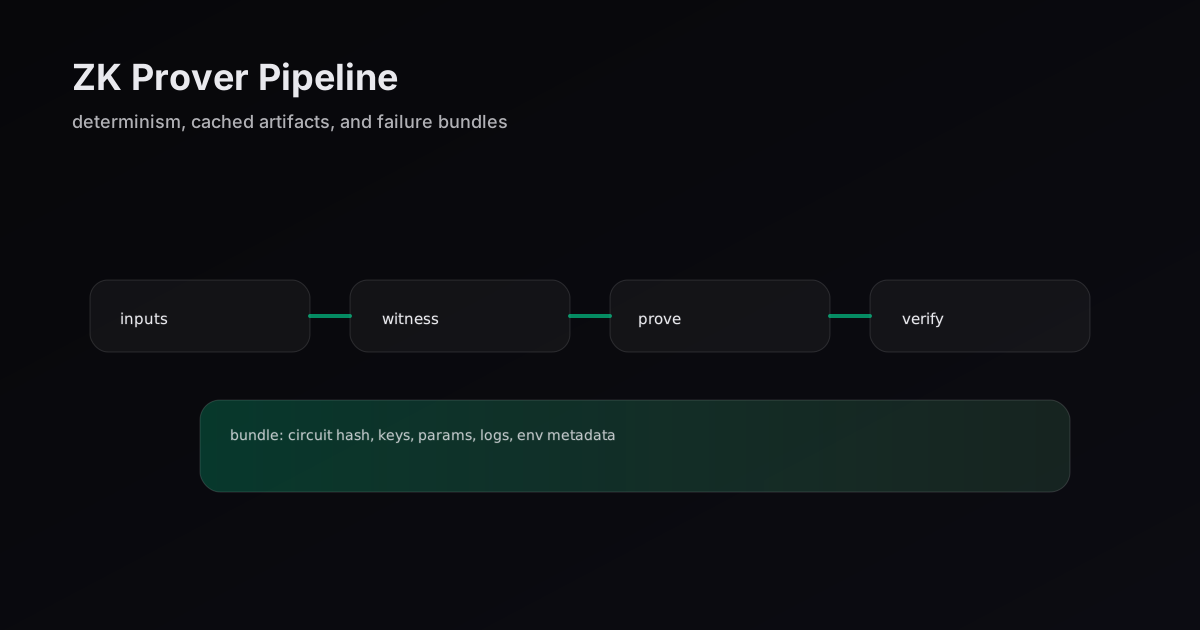
ZK engineering feels hard because you're building a compiler toolchain and a distributed system.
The security twist is what makes it unforgiving: if you can’t reproduce proofs and failures, you can’t audit your own pipeline.
This post is a pipeline blueprint that keeps teams shipping: determinism, caching, artifact hygiene, and failure triage.
1) Determinism is a security control#
If you can’t reproduce a proof locally, you can’t reason about regressions.
Make the pipeline deterministic:
- pin compiler versions
- pin circuit parameters
- content-address artifacts (hashes)
- log randomness (or eliminate it)
A rule I enforce: every proof run emits a bundle that can be replayed.
2) Treat parameters like consensus rules#
In Solidity, “wrong chainId” breaks signatures.
In ZK systems, “wrong verifying key” breaks everything.
Here’s a useful artifact table:
| Artifact | Why it matters | Typical failure |
|---|---|---|
| circuit hash | binds behavior | subtle drift between builds |
| proving key | prover correctness | mismatch across environments |
| verifying key | verifier acceptance | proof rejected (or mis-verified if coupled wrong) |
| transcript log | debugging | opaque failures |
3) Cache or your team stops testing#
Most ZK projects die because proving is slow and dev feedback loops collapse.
Cache layers:
- compiled circuits
- proving/verifying keys
- witness generation outputs keyed by input hash
If a cache entry is invalidated, log why.
4) Failure bundles (the best debugging tool you’ll build)#
When a prover fails, you want a single bundle you can hand to someone else.
Include:
- inputs
- witness (or partial witness)
- circuit + key identifiers
- logs
- environment metadata
If you can bundle failures, you can fix them. If you can’t, you’ll argue about “it worked on my machine” forever.
What “environment metadata” means#
Include:
- git commit
- compiler versions
- CPU features (yes, it matters)
- OS
- flags used
ZK stacks can be sensitive to subtle differences.
5) A minimal CLI that scales#
If you only build one interface, build this:
prove --input inputs.json --out proof.bin --bundle bundle.tgz
verify --proof proof.bin --input inputs.json
replay --bundle bundle.tgz
A pipeline that supports replay is a pipeline you can audit.
6) Make proofs legible in logs#
When proof generation fails, logs should help you locate the layer:
- witness generation failures: constraints unsatisfied, missing assignments
- prover failures: key mismatch, transcript mismatch
- verifier failures: wrong VK, wrong public inputs
A simple technique: add “phase markers” to logs and emit sizes/hashes at each stage.
7) Security checklist (pipeline edition)#
This is what I ask before I trust a ZK pipeline:
- Are artifacts immutable and content-addressed?
- Can two developers reproduce the same proof byte-for-byte?
- Does verification bind to the correct verifying key and domain?
- Are there environment-dependent branches (endianness, CPU features, randomness)?
- Do you have an incident playbook for invalid proofs in production?
Watch: ZK proofs as an engineering system#
This Ethereum Engineering Group talk is a good complement if you want intuition for where ZK engineering complexity comes from (and why “pipeline correctness” becomes a security property).
Further reading#
- Matter Labs resources: https://github.com/matter-labs/awesome-zero-knowledge-proofs
- ZK primer (non-handwavy): https://blog.cryptographyengineering.com/2014/11/27/zero-knowledge-proofs-illustrated-primer/